Showing posts with label seasons. Show all posts

Thursday, August 25, 2016

Four Seasons in Rome

No, I'm not headed off to Rome for a year.


Anthony Doerr did, as part of a year-long artist fellowship he won. He, his wife and six month old twin boys traveled from their home in Idaho to an unknown apartment in an unknown city in an unknown culture speaking an unknown language (except the four hour crash course in Italian he took on a Saturday morning before they left). The journal he kept during that year became this book, Four Seasons in Rome.

"A good journal entry - like a good song, or sketch, or photograph - ought to break up the film that forms over the eye, the finger, the tongue, the heart. A good journal entry ought to be a love letter to the world."
The stories of their walk through the four seasons there, a few blocks from the Vatican, is subtitled, On Twins, Insomnia, and the Biggest Funeral in the World. Beyond recording the events, the adjustments, and the challenges, the book, for me, is a lesson in How-to-Journal.

"A journal entry is for its writer; it helps its writer refine, perceive, and process the world."
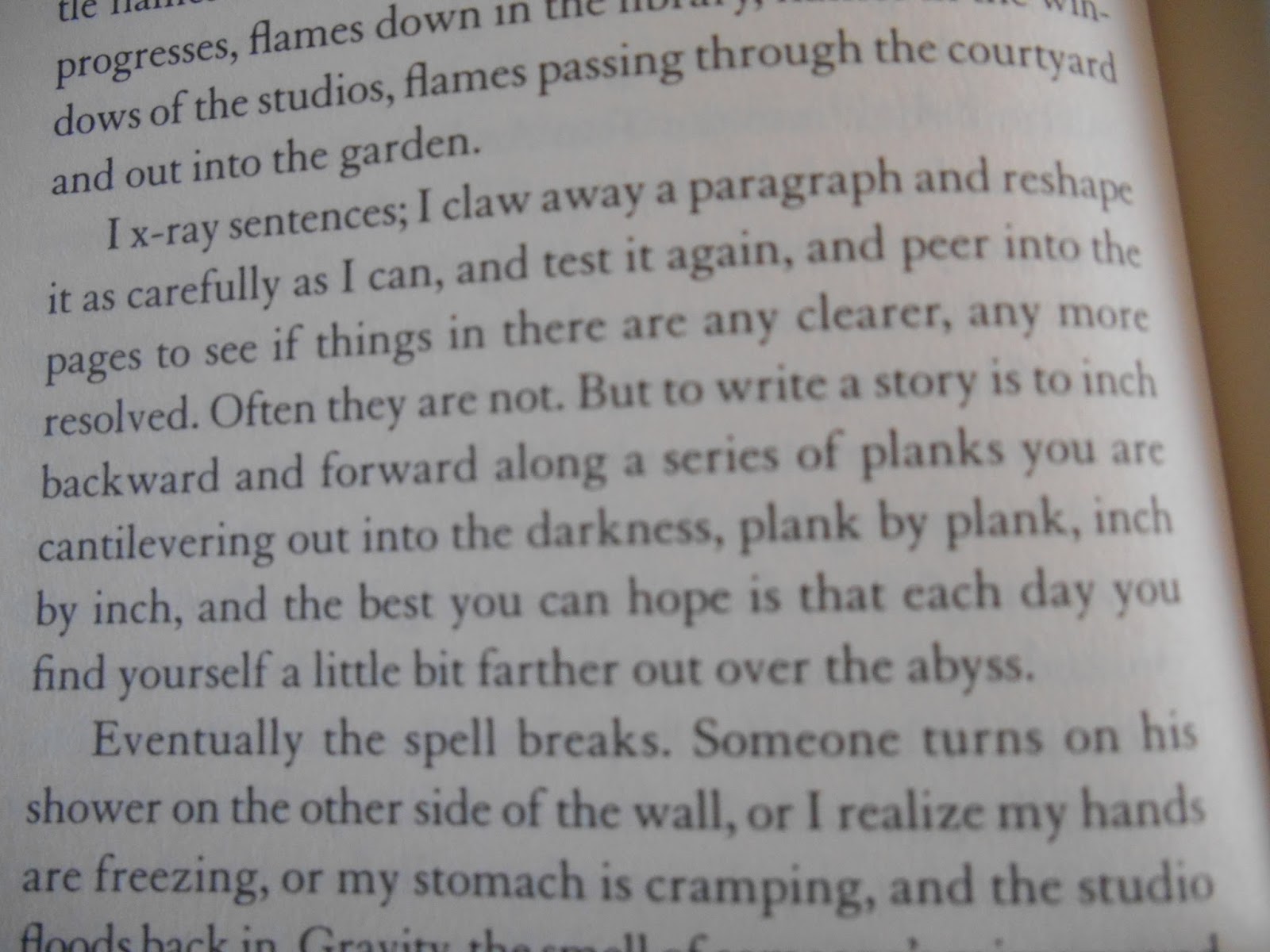
The five senses are recorded throughout - a means he uses to process his memories, and a vibrant way for the reader to be involved in the scenes he records. Sights, smells, tastes, touch, and sounds - all carefully, thoughtfully woven through his words. Standing shoulder to shoulder with mourners as the pope dies, and later, pushing their double stroller through the crowd of celebrants as the new pope is chosen. Describing to a baker, the rich bread smells around them, the focaccia bread he wants to order, misunderstanding the frustration, realizing later he was asking, in his broken Italian, for grapefruit sauce. Discovering new foods, making new friends, listening to the language, learning to understand it. Hunting down those vivid details, linking them together to build a sequence of thought, to "stay alert to the miracles of the world."

"A year is an infinity of perceptions: not just the shapes of starlings and the death of the pope and watching our sons learn to walk, but the smell of roasting meat in an alley, the dark brown eyes of a beggar on a church step, a single dandelion seed settling soundlessly onto the habit of a nun who is riding the train. This year has been composed of a trillion such moments; they flood the memory, spill over the edge of journal entries. What is it physicists tell us? Even in a finite volume, there are an infinite number of points."

In a way, this is discouraging. An infinite number of points? How could I ever catch them all? But that's not the point. Grab one. Grab two. Catch three. Record those vivid details, link together the sentences that help a reader (and me, the writer!) to see, smell, touch, taste and hear a world of beauty and miracles.

Anthony Doerr quotes Marilynne Robinson,
"There are a thousand thousand reasons to live this life, every one of them sufficient."

I think of Mary Oliver's poem,
"PAY ATTENTION
BE ASTONISHED
TELL ABOUT IT." 
Keeping a journal has been important to me for years. I have a box of old journals stashed in a closet. Never for publication, but for me to thumb back through if I am looking for notes, or find when something happened, or just for browsing. This book, Four Seasons in Rome, is not only an interesting read of their year as a family, as an artist, as an author, as part of a community, but also of the way he perceived and responded to the world around him, brilliant at capturing those images, and how he stayed alert to the miracles of the world. Now, when I write in my journal, I pay attention - not just recording feelings (as in emotions), but capturing a moment in time, using the senses as a means of paying attention, and searching for the right words.

I tried to find a good example of how he incorporates the senses in his sentences. It is an overall impression he leaves. I would call his journals, Impressionistic Journaling. Like the impressionist painters that paint in various dots and smudges and blends of color, but leave a distinct image on the canvas, he paints images with his words that leave a distinct image. Powerful, beautiful writing.

"Everything is radiant. Distant trees toss, faraway walls gleam. The mountains at the horizon have switched on like streetlights, stark and defined, giving way to more distant ranges.
Then everything goes dark again, the clouds knitted together, the mountains sucked back into silhouette, Rome sinking into shadow."

Wednesday, March 16, 2016

The Road Less Traveled


The Road Not Taken

"Two roads diverged in a yellow wood,
And sorry I could not travel both
And be one traveler, long I stood
And looked down one as far as I could
To where it bent in the undergrowth;
Then took the other, as just as fair,
And having perhaps the better claim,
Because it was grassy and wanted wear;
Though as for that the passing there
Had worn them really about the same,
And both that morning equally lay
In leaves no step had trodden black.
Oh, I kept the first for another day!
Yet knowing how way leads on to way,
I doubted if I should ever come back.
I shall be telling this with a sigh
Somewhere ages and ages hence:
Two roads diverged in a wood, and I—
I took the one less traveled by,
And that has made all the difference."

This poem, by Robert Frost, is a favorite. I have probably quoted it here, before.
We found this painting at a thrift store, and "had" to add it to our collection of mountain paintings, destined for our cabin walls once they are finished, beyond the stud stage.  

Since the time change, I have noticed new lighting patterns, the shift of the sun's position and the timing of the sun glow across the walls and floors. Right now, the evening sun shafts across this road, framing it in gold, making what is around that corner almost visible.


Our cabin in the mountains could be right around that corner, the road, its invitation to come and stroll, to welcome the quiet, or hear the wind waves through the trees. 


Signed Stanley Awbrey, 1973, it could have been painted on the road we take, the road to our cabin, one autumn day. I imagine a few deer strolled by while he sat and painted, a chipmunk paused a moment to watch, and blue jays chattered overhead at his plen-air intrusion into their quiet world. I have no idea who Stanley Awbrey is, or where he is now, or what he was like, but I am grateful he took the time to create this moment, preserved in time, for us to enjoy years later.

If I could be like Edmund and Lucy and Eustace and jump into a picture, this would be it. Oh, wait. We do jump into this painting when we go to the mountains, creating our place, there. This reminds me what a privilege that is, and I am grateful.

Tuesday, March 31, 2015

March In Review

Joining here with Emily Freeman, Chatting At the Sky, and others, to share as we glance in the rear view mirror and prepare to move ahead into April, equipped with all we learned in March.

March Lessons:

1. Austin Kleon, author of Steal Like An Artist, (great book), wrote on his blog a phrase I love.

                                                          mise en place

Love the sound of that (even though I won't pretend to say it with a French accent). It is a French term chefs would use for everything in place, all ingredients in order and tools prepared and ready to create a delicious masterpiece. He writes..."For writers, I think it is equally important to have your workspace organized and ready to go, nothing in your way."

Actually, I can quickly find just about anything on my desk, even if it does look a mess, there is some order to the piles and it drives me crazy when I can't find something. But I love this phrase - wrote it on an index card to lean against the lamp as a reminder to create order, to think ahead of the tools I'll need, to be prepared. To work toward mise en place.

I know enough of myself, though, to know I do need to just start. Not wait until everything is perfectly in line - it is a goal - but the balance is to do something, to write, even in my messy place (the English mispronunciation).

2. Another blogger and author, Melissa Michaels of The Inspired Room, wrote of her definition of style. It is a style I can understand without worrying about color wheels or texture or whatever. Real life.

"When  I talk about style, I'm thinking about my authentic style of living at home, not how stylish I am (or am not!)...I don't need all the latest rules...I just need to learn to be more in touch with how my surroundings impact my life."

"My home is a reflection of who I am because I'm happy to be surrounded by stuff that matters to me and I can say good-bye to stuff that doesn't. What that means is: I have to continually refine my home to let go of the stuff I don't need, the stuff that distracts me, and embrace the things that inspire."

What inspires me?
books
plants
clean, uncluttered, uncrowded spaces
to know where everything is (even if it is in a pile)

She adds, "Creating an authentic home is a matter of personal reflection and the determination to make progress in letting go, as much as it is about what to add in."

I realized something. It may look like I collect books. What I am really collecting is words. I want to save them, savor them, remember them, and re-read them. More on this in #6.


3. Books I read this month:
Plain Simple Useful, by Terence Conran
Pottery Barn's Complete Book of the Home
The Power of Habit, by Charles Duhigg
The Happiness Project, by Gretchen Rubin
How to Grow More Vegetables, by John Jeavons
Propagation Basics, by Steven Bradley
In January and February, I read all fiction. The Hobbit, the Lord of the Rings Trilogy, and the first four Harry Potter books. It felt good this month to go back to all non-fiction, but I will mix it up a bit, for next month.


4. Thursday is my final class for the Colorado Master Gardener course. It has been so much fun to meet one day a week with like-minded plant lovers, to learn just how much we didn't know and still don't know about plants. Lugging our textbook around has built up muscle to prepare for the soon-to-be-here gardening season.

I am not a scientific thinker. Quick impressions and emotional response are more my speed. However, it has been fascinating to dig into the whys of plant growth, plant health, and plant identification.

At our mountain cabin, I recognized the trees are not all identical pine trees. I was able to use the identification key (like a computer flow chart) to discover we have three different types of conifers: Ponderosa Pine, Pinon Pine, and Rocky Mountain Juniper. Now, I see the trees in a completely different way, and around town I can recognize the variety of trees. Once the shrubs green up, I'll be able to identify and learn more about them, too.

On a Nasa website, they say, "Anyone can think like a scientist."
Science is . . .
  • Observing the world.
  • Watching and listening
  • Observing and recording.
Science is curiosity in thoughtful action about the world and how it behaves.
Anyone can have an idea about how nature works. Some people think their idea is correct because "it seems right" or "it makes sense." But for a scientist (who could be you!), this is not enough. A scientist will test the idea in the real world. An idea that predicts how the world works is called a hypothesis.
Hmmm. Is my hypothesis correct?
If an idea, or hypothesis, correctly predicts how something will behave, we call it a theory. If an idea explains all the facts, or evidence, that we have found, we also call it a theory.


I came across this looking up something for my son's schoolwork.
It helps me realize I apply science in more ways than I thought, giving me a new appreciation for science and learning.
Observation.
Pay Attention.
Curiosity in thoughtful action.

5. I have written before of the benefits of aloe in treating burns. Do have an aloe plant in your kitchen? You should. The aloe plant I had before died, probably from overwatering. Three burns in three weeks convinced me I needed another plant.

Yes, I did. I grabbed a cookie tray fresh out of the oven. I can explain what I did, each step in slow motion - I can't explain the logic of it. Oh, it hurt. Six blisters on five fingers, my whole palm red and shiny. I split open a long aloe leaf, soaking my fingers in the cool, slimy juices. Over and over, wiping the fluid across my palm and fingers, gently rubbing it in. For an hour or so.

Our son, the day before, made some aloe jelly, a project from a Junior Master Gardener lesson book we are working through. The juice, scraped out of one leaf, mixed with hand lotion, kept in the refrigerator. I applied it to my palm and fingers several times during the evening.

The next day the pain was gone, the reddness gone, the blisters flat and soft, not raised or raw. Two days later, the two worst blisters were flat, brownish spots, the rest, gone. Amazing, especially as two of the previous burns were still ugly red lines.

Do you have an aloe? I will try very hard not to overwater this one. And, I will try not to burn myself (I do try not to, really!). I seem to have a knack for this - best to keep an aloe handy.

6. Paper. Pen. Pocket.
In "Becoming Jane", the movie biography of Jane Austen, she hears a phrase she likes, pulls a paper and pen out of the pocket in her apron, sits down on a nearby bench and jots it down. The grumpy lady asks, "What is she doing?" The young man, who understands her, answers that she is writing down words, or something like that, I don't remember exactly. Jane Austen was a collector of words, and she was smart enough to write them down immediately. I assume I will remember them later, but rarely do. I learned I do need to carry pen and paper, tucked in a pocket so they are always close at hand, available and ready to jot down a thought or a phrase or that perfect line. To collect those words.

That line she jots down makes it into Pride and Prejudice, "Miss Bennet, there seemed to be a prettyish kind of a little wilderness on one side of your lawn. I should be glad to take a turn in it..."
I love how the words she collected became the classic story.

Being a word collector, I collect quotes, thoughts, word images, stories, characters told in words. Why be a word collector? Because they are thoughts of people past and present - thoughts in tangible (sort of) form. Like being able to grab and hold a thought. Which I can't do, and which is why I write down the words. And collect them.

7. Our daughter shared with me a phrase she heard,
                                      THE EINSTEIN HOUR

That time of day when you are at your best, sharpest, most productive, most clear thinking. Plan for that time, use it for your best work. Right now, for me, that is 8 to 9 am. I mark that out on my planner pages and use that time to write. It helps me to have that hour set aside. Ideally, I would like to write much longer than that, but an hour done is far better than just intentions, and for me, real progress. The specific time may change as life changes, but think about when you are at your best. Pay attention to that productive time - use it for your best - it may mean reading with children, walking, cleaning - find your Einstein Hour and use it wisely. What is your Einstein Hour?

So, March accomplished.
April ahead.
Wonder what lessons April will offer?


Monday, March 2, 2015

Martina's Cornbread


New cookbooks are fun to browse and explore. Some recipes work, and some - well, they are not put in the repeat category. This new cookbook, by Martina McBride, Around the Table, gives an interesting insight into her family life, her home, her style, and, of course, how she cooks. The focus of the cookbook is on hospitality, on the events and occasions and just-because times she welcomes others into her home. Each section has decorating ideas, music playlists (of course - what else would you expect from a musician?), menus, recipes, gorgeous photos, and practical tips for welcoming others into your home and life. And we have several new recipes that are definite repeats.

Her recipe for cornbread has become a frequent staple here. I cut it in half, this is a party sized batch.

Cornbread With Green Chiles And Pepper Jack Cheese

5 tbsp unsalted, melted butter
2 tbsp butter for greasing the pan
1 1/2 c buttermilk
1 1/2 c milk
4 large eggs
2/3 c vegetable oil (I use olive oil)
3 c all purpose flour
1 c ground yellow cornmeal
2/3 c sugar
2 tbsp baking powder
1 tsp salt
1/4 tsp ground pepper
1 4oz can diced green chiles
1 c shredded pepper jack cheese

Preheat oven to 350. Generously grease a 13 x 9 baking pan with 2 tbsp butter.

Combine the buttermilk, milk, eggs, oil and melted butter in a large bowl. Combine the flour, cornmeal, 2/3 c of sugar, baking powder, salt and pepper in a large bowl.

Add buttermilk mixture to the flour mixture, stirring until just combined. Stir in the green chiles and the pepper jack cheese. Pour the batter into the prepared pan. (She sprinkles an additional 2 tbsp sugar over the batter - I omit this).

Bake for 40 to 45 minutes or until a wooden toothpick inserted into the center comes out clean.


We're serving ours tonight with chicken enchiladas, Confetti Rice (also from her book) and salad.


This is my favorite of her songs. I have posted it before, but I think it is worth hearing again. And again. "Do It Anyway." A great theme song.


(Guess this cuts off just before the end - sorry. It's still worth the listen, just keep singing it in your head)

Thursday, September 19, 2013

Random Rambles, Part One


My plants are thriving with the subtle shift to fall weather. Warm days, with cool breezes. They are bursting with one last shout of color and productivity, setting up their seeds, preparing for the winter.

Yup, the zucchini, too. I thought they slowed down, but they, too, seem to be putting forth one last effort. Which means a bunch of zucchini to deal with. My neighbor said she would take some - she was smart enough not to plant them because she knows what happens. Not to say I won't plant any next year. I am sure I will. But, there are moments when it is just too much.

I made a batch of zucchini bread that was dry and bland. That failure helped me remember a recipe from my sister-in-law, Cathy. When we were newly married, we lived near them in the Denver area. Whatever she grew flourished and whatever she cooked was yummy - I learned a lot from her in my early wife days. I dug back through old, stashed recipes and found this, in her own writing. A nostalgia moment. The paper was torn, stains splashed on, obviously a well used recipe.


Zucchini Bread
3 eggs, beaten
1 c cooking oil
2 c sugar (I used a little less)
2 c grated zucchini
2 tsp vanilla
3 c flour
1 tsp soda
1/2 tsp baking powder
1 tsp salt
1 tsp cinnamon
1 c chopped walnuts or pecans
1 c crushed pineapple

Grease and flour two loaf pans or one cake pan. Beat eggs, add oil, sugar, zucchini and vanilla. Beat.
Then add flour, salt, soda, powder and cinnamon. Mix well. Add nuts and pineapple.
Bake, 325 degrees, for one hour.
"This is really moist and freezes well," Cathy added at the end.


Do you ever roast vegetables? It is a yummy, easy way to cook them. Pop them in the oven with some chicken for a simple and quick dinner. Last week I wrote about eating a rainbow of fruits and vegetables.
Roasted Rainbow
Red - red peppers
Orange - carrots
Yellow - summer squash
Green - zucchini
Blue - purple onions
Violet - beets
Potatoes
Cut vegies, any combination of colors, in slices or wedges, spread in 9x11 glass baking pan. Sprinkle with olive oil and Italian seasoning, stir. Bake 350, an hour or a little longer until tender, stirring once to help cook them evenly. I added the zucchini and yellow squash at the halfway point, as they tend to get overcooked.
Have you used a Misto? I used a cooking spray for years, loving the convenience, knowing the chemicals used to make it spray weren't good. I found mine at Bed, Bath and Beyond. Add 1/3 cup olive oil, pump it six or seven times, spray. It needs to be refilled now, a couple of months later. No nasty chemicals, just pure olive oil. With the convenience.


Wednesday, August 14, 2013

Keep the Hope

Do you remember the post in February about the plant my son said, "Didn't make it?"

Here it is, now, three times the size, full of blooms and bees and beauty.

Seasons change. Life changes.

Keep the hope.


Monday, June 24, 2013

A Summery Welcome

Welcome Summer

Come on in!


Our daughter put this wreath together this weekend - a bright and summery welcome for our front door.


The wreath is from an idea she saw on Pinterest - a dollar store swimming noodle held in a circle by duct tape.  Clever - I see many wreath possibilities in the future.

Makes me smile when I see the cheerful greeting at our door.


Friday, June 7, 2013

Each Day a Gift

Joining the Five Minute Friday group, a free-write five minutes, stringing words into a collage of thoughts.


Five Minute Friday

FALL

They say middle age is like the fall of life.

Spring, birth.
Summer, childhood.
Winter, old age.

That leaves an awful lot for fall.

Young adulthood, maturing, grasping life and eagerly exploring your path, finding your way.
Enjoying the fruits of your labors in home, children, family, grandchildren.

That's way beyond one season's capacities.
And too depressing if you are, like me, edging toward those "winter" days.

I prefer to think of each day as a span of the seasons.

The morning springs bright and fresh, eager with possibilities.

The day warms into the work and productivity of summer.

As the family gathers around the table for dinner, the day wanes, the light fades, the work is set aside (even though the washing machine may still be running and there are dishes in the sink). It is time to recollect, to regroup, to enjoy and appreciate all we have, together. Fall is about in-gathering, drawing close, creating a snug haven.

The night, dark and cool, settles over, bringing in the quiet and rest of winter.

Every day is a pilgrimage through the seasons, embracing the gift of life.


Wednesday, May 1, 2013

It's Risky

Yesterday, I wavered and wondered and debated and wishy-washed, should I, or shouldn't I?

And the questionable issue? Do I wait to plant out my baby seedlings with snow predicted (again!), or do I risk it and put them out? Now, obviously, this is not a life critical problem. But it got me thinking about taking risks, about my attitudes and fears when I come to a risky situation.

  • what is the worst that can happen?
  • how much would I lose?
  • what could I gain?
  • why am I afraid?
  • how could [this] be worse than [that]?
  • how could [this] be better than [that]?
  • what could I learn?
  • what are my options, how can I think creatively?
  • will the consequences require faith (a good thing)?
What other questions would you think of?

Once I analyzed my resistance and the potential consequences, the decision was easy. Plant the seedlings. 

The worst that can happen is they will freeze and I will have to replant. Not a huge deal. This is the first time I planted seedlings inside under a florescent light, and I learned a lot - those lessons will stay with me even if the plants don't.
Am I afraid the experiment won't work? If I'm afraid to try anything new, I'll never get out of bed in the morning (which some mornings, might be tempting...)
If I leave them under the florescent light while we are gone for ten days, they will probably dry out, shrivel up, and I'll lose them anyway. If I plant them outside, they might survive and actually be bigger and stronger when we get back.

Judging by the crazy weather this spring, with a snowfall every week in the middle of eighty degree days, the plants will have plenty of warm days - if they survive the freeze tonight. I can take the precautions of mulching them heavily with straw and blanketing them with a cloth covering which will give them a ten degree advantage.

Because we are living in a new climate, I need to stretch my boundaries and knowledge of what plants will do here. Which means trial, and of course, error, and not to be afraid of the error side of learning.

You may laugh at my over-analytic, wishy-washy thinking. Over a bunch of little seedlings. The lesson I am taking away from this, is that, too often, I put off making a decision. I wait for more information. I wonder and wander and debate myself out of making a choice. Instead, I need to ask these questions, form answers and make the choice. Get rid of the baggage of vacillation and move forward, traveling lighter.

I planted all the seedlings. And yes, it is snowing today. I took the risk. I hope they will stay warm and snug under their blanket of straw and fabric cover. When the sun comes out again, they will perk up, stretch toward the light, and grow.

Me, too.

Thursday, February 7, 2013

In the Off Season

We stepped out the front door, towed by the dog at the end of her leash. She loves her walks.

My son commented as he stepped off  the porch, nodding at a sparse shrub, "That didn't make it, did it."

I said, "Hey, it is winter. It is supposed to look like that right now." And, I resisted the urge to talk to the plant and assure it it would be okay, just hang in there (I'm a bit odd like that with my plants).

The plant is a Russian Sage, covered with lavender-like blooms summer through fall. They do very well here, blooming for months with little care, and lots of houses have them in their yards. As we walked, I noticed how the bigger, older, established ones looked just the same as my little one, planted last fall. Except bigger, of course.

We won't know for sure if it survived its first winter until spring. I have watered it when the days are above 50 degrees, according to the nursery directions. This dry, cold winter is hard on young plants and they need extra moisture even when they don't look alive.

Walking the neighborhood, noticing the dry, scraggly shrubs in people's yards, it made me think. How often do we throw something out - an idea, a relationship, a skill - because it doesn't look full or beautiful or finished or valuable.

That idea may be in the beginning stages. Barely fleshed out, more of an image than a full blown concept. It may need water and nourishment. It may need a bit of pruning back those bare branches. It may need time. Time to deepen its roots and reach into the ground for moisture and nutrients and strength to hold firm against the blustery winter winds. Time to fill out.

That relationship may not look like much. Barely even a relationship, really. People need time. Time to flourish and bloom, and sometimes time to rest and sit through a season of stillness. Waiting. Growing in invisible ways. Valuable. A relationship takes time. Giving time, waiting time.

That skill. Any skill grows through spurts and plodding. A skill like playing the piano. Hours of practice. The same lines over and over and over. Progress, stumbling over the keys, fumbling with the timing, the technique, working and re-working the hard parts, struggling along. And one day, the notes flow through the fingers, perfect and beautiful. Melodious.

My little Russian Sage will be pretty come summer, enjoyed every time we step off the front porch. I will notice it, even if our son doesn't. Now, in the off season, it doesn't look like much. Barely even looks alive. But come warmer weather, it will begin to sprout tiny green leaves, filling all those bare branches with green, and budding into lavender colored bursts come summer. What appears dead and bare now, will become beautiful, in its season.
A hedge of Russian Sage in the summer

Thursday, January 17, 2013

Wednesday, January 16, 2013

Monday, January 7, 2013

Monday, December 31, 2012

Happy New Year


Close the door on 2012.
Open the door to 2013.

My blog plan for January is to spend a quiet month, posting a photo each day. I will probably toss in a few words here and there, thinking a picture can't possibly be worth a thousand words without my help. But mostly, I will try to stay quiet.

I know you all are busy with your own planning and re-grouping for the new year. I'll take the month to work on a few projects and find the space to breathe, deeply. Let's relax, take a deep breath together, and look forward to all that 2013 has for us.

Happy New Year!

Thursday, December 27, 2012

The Day After Christmas


A Short Story


As Beth opened the door of the coffee shop, bells jangled from the handle. Caught between the inside air and the crisp wind outside, her ponytail blew around her face, her denim skirt twisted around her legs. She closed the door, pushed her hair and skirt back where they belonged and inhaled the sweet, bitter, cozy scent of coffee. Jess waved to her from her corner table. The door opened behind her, the wind grabbed her hair and skirt again. She stepped aside to make room as Cara stepped inside.

The two friends greeted and walked over to join Jess, waiting for them with three cups of pumpkin spice coffee.

“My favorite part of Christmas is when it’s finally over,” said Cara as she plopped into her chair and took a sip from her cup. “Thanks Jess, this is good.”

“Don’t talk like that,” said Beth.

“You don’t have to survive my family,” said Cara. “The hateful glares between my mom and dad. My grandma lecturing my dad about all he should or shouldn’t have done while ‘Silent Night’ plays in the background. No, I am glad when the holidays are over.”

“Don’t you enjoy any of it? What about the music or the food or the decorations?” asked Beth.

“No, it all reminds me of what our family isn't. I can’t see past the animosity and resentment.”

Beth turned to Jess, “How was your Christmas?”

“You make me feel guilty, Cara. We all got together, had lots of presents and loads of food and lots of fun.”

“How about you, Beth?” asked Jess.

“After church, we each opened one gift, we had our big meal, read the Bible and sang hymns, each picking our favorite.  Later, we went to the convalescent home where my grandpa lives and my dad led a service for all the dozing old people. It was delightful.”

“You don’t sound too thrilled with Christmas, either,” said Jess.

“In my family, there is so much focus on what is right or Scriptural we forget to have fun.  We have to ‘do’ Christmas instead of having a relaxed, easy, happy, together Christmas.”

Jess leaned back in her chair. “There is such a huge build up before Christmas. Seems it starts earlier each year.”

“And drops harder when it is over, when all the disappointment and dissatisfaction hit. When you realize all you didn’t do or didn’t get or didn’t give. When the next three hundred and sixty-four days seem a relief,” added Cara. “I wonder if it is wrong to feel a sense of grief. Relief and grief, when finally, it is all over.”

“I don’t think it is wrong. Recognizing your feelings is a good thing. What you do with those feelings is what matters,” said Jess. “Acknowledge your feelings of sadness, regret." Jess paused, "Cara, can you think of three good things that did happen?”

“Three things?” She counted them off on her fingers. “Well, my dad did try to say something nice to my grandma instead of fighting back, even when she was hounding him. My brother and I had fun building a puzzle together.  The mashed potatoes turned out well even though I tried a new recipe.”

“There you go. Three things to appreciate and remember, with a smile and gratefulness. Does that change your perspective?”

“Yes, I guess it does,” said Cara. “Guess I could come up with more good things, too, if I tried.”

“Exactly. Isn’t that the message of Christmas?” asked Jess. “The gift of love, shared with us, right in the middle of our messy lives. Right where we are.”

“I can see what you are saying,” said Cara. “It would be hard to be angry and bitter if I think about loving, kind things.”

Beth added, “I can see that I need to work on my perspective, too. To see all I do have in my home and family, instead of thinking about all I think we don’t have. We do have some fun together, even if it isn’t exactly like I would like it to happen.”

“Look,” laughed Jess. “I am not trying to be a psychotherapist or something. But being grateful makes a huge difference. Focus on the negative, and that is what you will see. Focus on the good, even if it is just a little, and the little grows bigger.”

The three girls sipped their coffees, quiet with their own thoughts.

Cara said, “I came here to unload and complain to both of you, expecting you to sympathize with me. Instead, I see Christmas in a different light. A light, kind of like the Christmas star shining over everything.  Gratefulness, illuminating, shining light on the beautiful and on the ugly parts of life.”

“I like that,” said Beth. “The manger scene, the shepherds in the field, all lit up by the light of the Christmas star. Right where they all were, busy with their lives, their work. The light shining over all of it. And here, now, each of us with our own family challenges. The light shining over us, too.”

“Makes me almost look forward to next Christmas,” said Cara, and the three girls laughed.

Thursday, December 20, 2012