Showing posts with label light. Show all posts

Thursday, August 25, 2016

Four Seasons in Rome

No, I'm not headed off to Rome for a year.


Anthony Doerr did, as part of a year-long artist fellowship he won. He, his wife and six month old twin boys traveled from their home in Idaho to an unknown apartment in an unknown city in an unknown culture speaking an unknown language (except the four hour crash course in Italian he took on a Saturday morning before they left). The journal he kept during that year became this book, Four Seasons in Rome.

"A good journal entry - like a good song, or sketch, or photograph - ought to break up the film that forms over the eye, the finger, the tongue, the heart. A good journal entry ought to be a love letter to the world."
The stories of their walk through the four seasons there, a few blocks from the Vatican, is subtitled, On Twins, Insomnia, and the Biggest Funeral in the World. Beyond recording the events, the adjustments, and the challenges, the book, for me, is a lesson in How-to-Journal.

"A journal entry is for its writer; it helps its writer refine, perceive, and process the world."
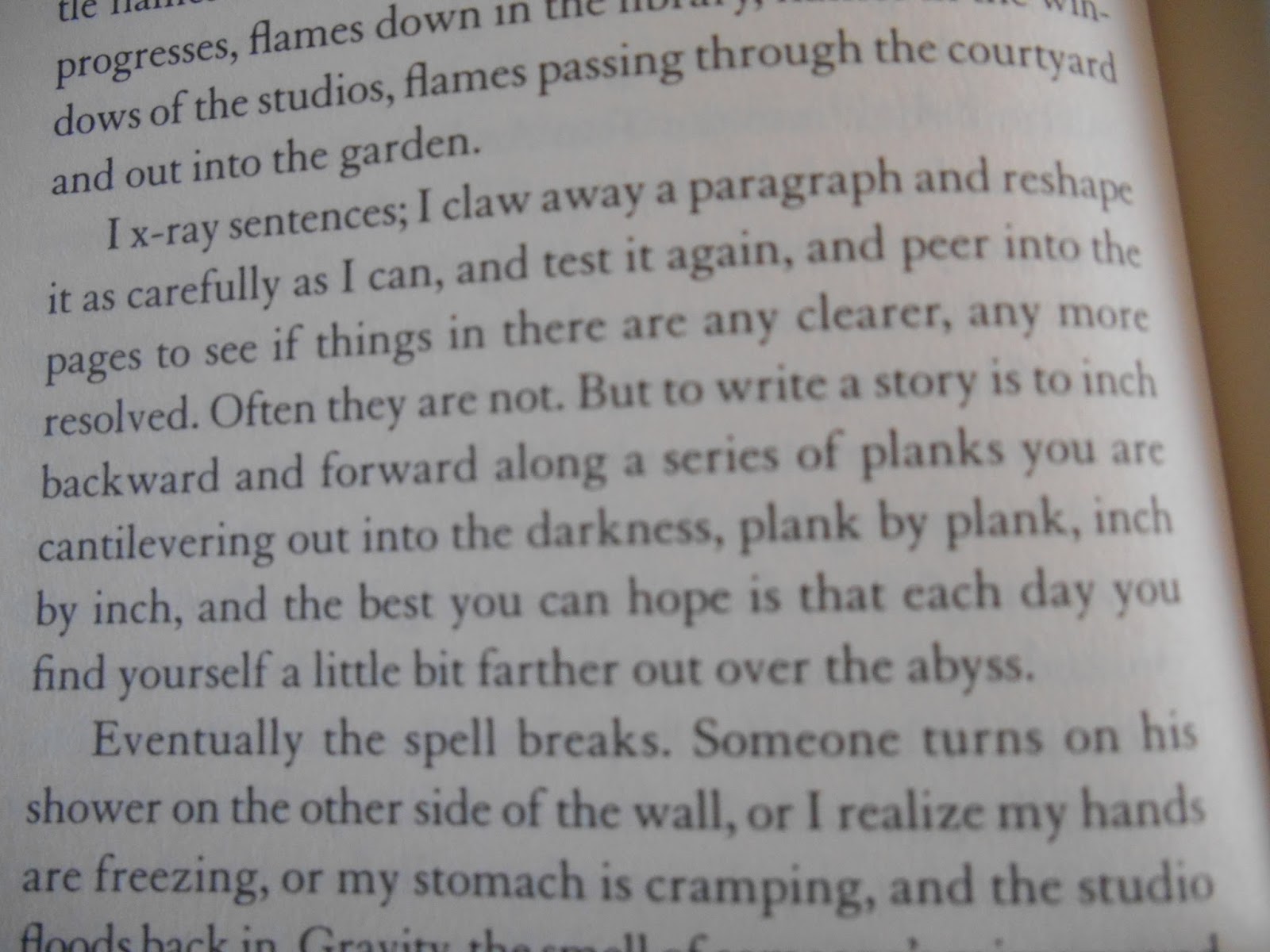
The five senses are recorded throughout - a means he uses to process his memories, and a vibrant way for the reader to be involved in the scenes he records. Sights, smells, tastes, touch, and sounds - all carefully, thoughtfully woven through his words. Standing shoulder to shoulder with mourners as the pope dies, and later, pushing their double stroller through the crowd of celebrants as the new pope is chosen. Describing to a baker, the rich bread smells around them, the focaccia bread he wants to order, misunderstanding the frustration, realizing later he was asking, in his broken Italian, for grapefruit sauce. Discovering new foods, making new friends, listening to the language, learning to understand it. Hunting down those vivid details, linking them together to build a sequence of thought, to "stay alert to the miracles of the world."

"A year is an infinity of perceptions: not just the shapes of starlings and the death of the pope and watching our sons learn to walk, but the smell of roasting meat in an alley, the dark brown eyes of a beggar on a church step, a single dandelion seed settling soundlessly onto the habit of a nun who is riding the train. This year has been composed of a trillion such moments; they flood the memory, spill over the edge of journal entries. What is it physicists tell us? Even in a finite volume, there are an infinite number of points."

In a way, this is discouraging. An infinite number of points? How could I ever catch them all? But that's not the point. Grab one. Grab two. Catch three. Record those vivid details, link together the sentences that help a reader (and me, the writer!) to see, smell, touch, taste and hear a world of beauty and miracles.

Anthony Doerr quotes Marilynne Robinson,
"There are a thousand thousand reasons to live this life, every one of them sufficient."

I think of Mary Oliver's poem,
"PAY ATTENTION
BE ASTONISHED
TELL ABOUT IT." 
Keeping a journal has been important to me for years. I have a box of old journals stashed in a closet. Never for publication, but for me to thumb back through if I am looking for notes, or find when something happened, or just for browsing. This book, Four Seasons in Rome, is not only an interesting read of their year as a family, as an artist, as an author, as part of a community, but also of the way he perceived and responded to the world around him, brilliant at capturing those images, and how he stayed alert to the miracles of the world. Now, when I write in my journal, I pay attention - not just recording feelings (as in emotions), but capturing a moment in time, using the senses as a means of paying attention, and searching for the right words.

I tried to find a good example of how he incorporates the senses in his sentences. It is an overall impression he leaves. I would call his journals, Impressionistic Journaling. Like the impressionist painters that paint in various dots and smudges and blends of color, but leave a distinct image on the canvas, he paints images with his words that leave a distinct image. Powerful, beautiful writing.

"Everything is radiant. Distant trees toss, faraway walls gleam. The mountains at the horizon have switched on like streetlights, stark and defined, giving way to more distant ranges.
Then everything goes dark again, the clouds knitted together, the mountains sucked back into silhouette, Rome sinking into shadow."

Wednesday, March 16, 2016

The Road Less Traveled


The Road Not Taken

"Two roads diverged in a yellow wood,
And sorry I could not travel both
And be one traveler, long I stood
And looked down one as far as I could
To where it bent in the undergrowth;
Then took the other, as just as fair,
And having perhaps the better claim,
Because it was grassy and wanted wear;
Though as for that the passing there
Had worn them really about the same,
And both that morning equally lay
In leaves no step had trodden black.
Oh, I kept the first for another day!
Yet knowing how way leads on to way,
I doubted if I should ever come back.
I shall be telling this with a sigh
Somewhere ages and ages hence:
Two roads diverged in a wood, and I—
I took the one less traveled by,
And that has made all the difference."

This poem, by Robert Frost, is a favorite. I have probably quoted it here, before.
We found this painting at a thrift store, and "had" to add it to our collection of mountain paintings, destined for our cabin walls once they are finished, beyond the stud stage.  

Since the time change, I have noticed new lighting patterns, the shift of the sun's position and the timing of the sun glow across the walls and floors. Right now, the evening sun shafts across this road, framing it in gold, making what is around that corner almost visible.


Our cabin in the mountains could be right around that corner, the road, its invitation to come and stroll, to welcome the quiet, or hear the wind waves through the trees. 


Signed Stanley Awbrey, 1973, it could have been painted on the road we take, the road to our cabin, one autumn day. I imagine a few deer strolled by while he sat and painted, a chipmunk paused a moment to watch, and blue jays chattered overhead at his plen-air intrusion into their quiet world. I have no idea who Stanley Awbrey is, or where he is now, or what he was like, but I am grateful he took the time to create this moment, preserved in time, for us to enjoy years later.

If I could be like Edmund and Lucy and Eustace and jump into a picture, this would be it. Oh, wait. We do jump into this painting when we go to the mountains, creating our place, there. This reminds me what a privilege that is, and I am grateful.

Thursday, August 29, 2013

Keep Your Face to the Sun

"Keep your face to the sunshine and you cannot see the shadow. It's what sunflowers do."

                                                                                                                          -Helen Keller

Reading aloud is a critical part of our home teaching day.  I love the moments when the older guys are drawn into the story we are reading, moving away from whatever they were doing in another part of the house to come listen as I read aloud to our youngest.

We are beginning this school year reading an autobiography by Helen Keller. Over and over again she uses words like see or listen or look or notice or visible beauty. A woman, blind and deaf. Sometimes, as we are reading, I have to comment on a sentence, to stop and realize that the author can neither see nor hear, yet she describes "the shimmering light of a Christmas tree," or "the noisy-throated frogs."

In June, I read The Music of Silence, an autobiography by Andrea Bocelli, a popular Italian singer, blind from age twelve. One of his teachers, "Dr. Marcuccio, also blind from an accident...had explained that even darkness was a visual sensation, and therefore, a perogative of those who have the gift of sight. 'The blind,' he added, 'cannot see darkness, just like the deaf cannot hear silence, which is an auditory sensation, the antithesis of sound.'"

Those of us with the gift of sight still need to learn to see. Even with the gift of hearing, we need to learn to listen.

 Helen Keller described the smell of an incoming thunderstorm. Do you know that scent? She described a scene, meeting people in a crowded room, shaking hands with "frosty finger tips, it seemed as if I were shaking hands with a northeast storm. Others...whose hands have sunbeams in them, so that their grasp warms my heart. It may be only the clinging touch of a child's hand; but there is as much potential sunshine in it for me as there is in a loving glance for others." Have you felt such awareness to touch?

 As a child, she loved the orchard, collecting apples and fuzzy peaches in her apron, the taste still warmed by the sun. Reading this autobiography aloud, together, gives us many opportunities to discuss the five senses and the beauty of our world. This gift, this perspective, seen through the eyes of a blind woman, gives us a deeper appreciation for the riches around us.

Saturday, March 9, 2013

Your Light


"Send out your light and your truth;
let them lead me..."

Psalm 43:3

joining the quiet Sunday community


and Still Saturday